

Overview
CryptoTensors is a file format that aims to provide strong confidentiality and controlled access for proprietary LLM weights while preserving the usability and efficiency of the Safetensors ecosystem.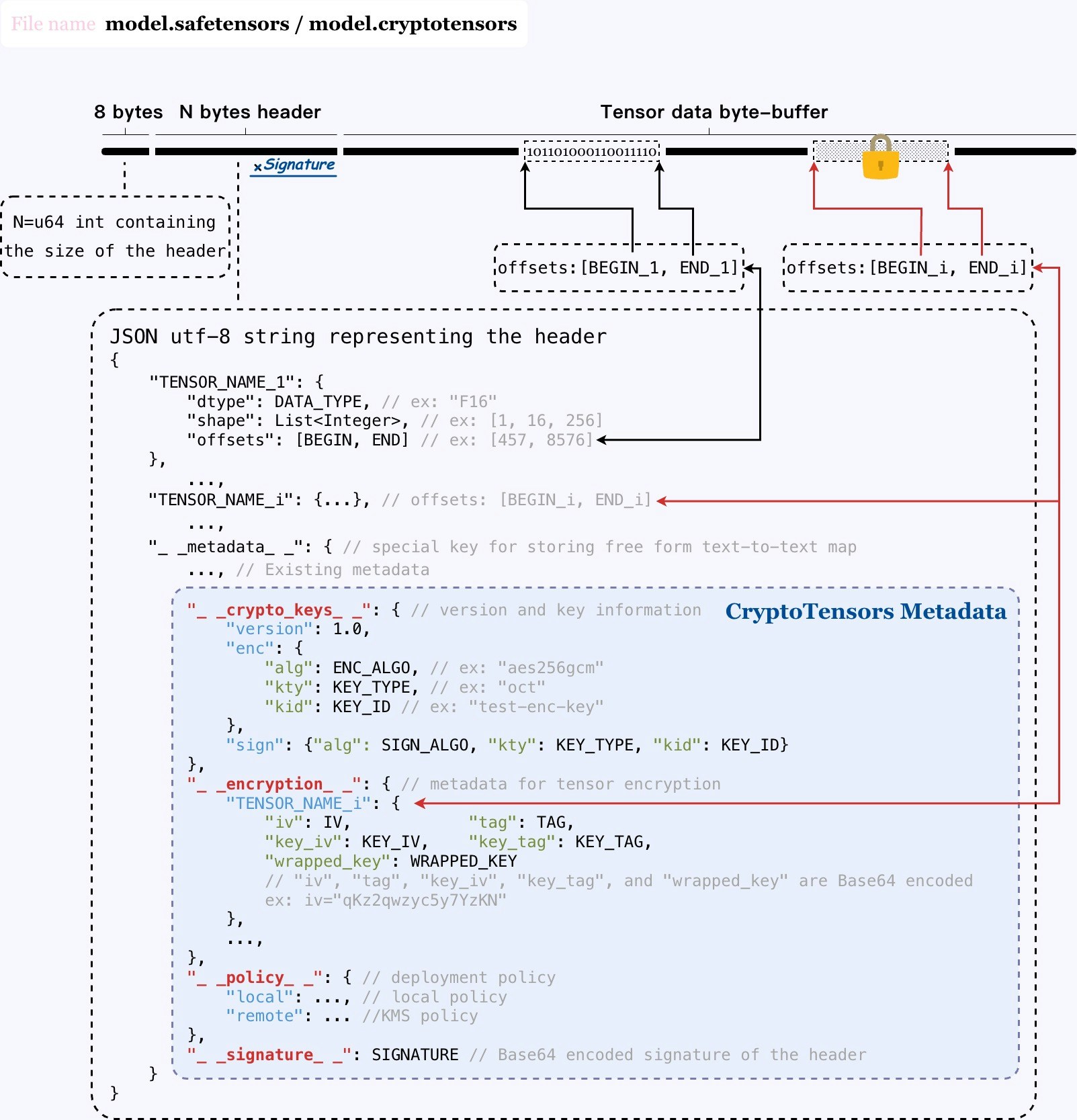
High-Level Design
Philosophy: CryptoTensors chooses to extend Safetensors rather than inventing a new format. Since Saftenosrs is one of the most popular and widely used tensor serialization formats for LLMs, it is a natural choice to extend and be compatible with it to leverage the existing ecosystem, tools, and frameworks. Cryptography Design:- CryptoTensors uses a header/body split strategy similar to Safetensors. The header remains plaintext (for tensor names, shapes, dtypes) to retain discovery and loading optimizations; the body holds the encrypted tensor payloads.
-
CryptoTensors uses a two-level encryption strategy per tensor:
- Per-tensor DEK encryption. Each selected tensor is encrypted with a randomly generated Data Encryption Key (DEK) and a unique IV (e.g., AES-GCM). This ensures ciphertext uniqueness and mitigates IV/key reuse.
- DEK wrapping. Each DEK is wrapped (encrypted) under a master key whose release is governed by the embedded policies (via KBS or local keying).
- The integrity protection of the model is achieved by a chain of signatures: the authenticity of the header is protected by a digital signature, combined with the two-level encryption strategy and AES-GCM’s inherent integrity protection. Overall, CryptoTensors provides the integrity protection for the entire file.
- The file format is self-contained, which means that the cryptographic metadata, policy references, and key source descriptors are embedded in the file itself. This allows for automated, policy-compliant decryption via KBS across diverse environments and licensing models.
Format Overview
CryptoTensors piggybacks on Safetensors’__metadata__ to introduce four signed metadata fields:
__crypto_keys__— JWK-encoded metadata for encryption and signing keys (e.g.,kid,jku,x5c), with URI-style sources:file://,https://,kbs://. Includesversionfor forward compatibility.__encryption__— Per-tensor encryption records enabling partial encryption. For each encrypted tensor: IV (iv), AEAD tag (tag), and the wrapped data-encryption key (wrapped_key) with its own IV/tag (key_iv,key_tag). Values are Base64-encoded.__policy__— Access-control policies in Rego (Open Policy Agent). Split intolocal(validated by the loader against the execution environment) andremote(enforced by KBS for key release).__signature__— Base64 signature over the entire header; verified by both loader and KBS to prevent tampering and to authenticate origin.
Serialization (Exporting Model) Workflow
At authoring time, the serializer:- Collects configuration: AEAD algorithm (e.g., AES-GCM-256), master key, signature algorithm (e.g., Ed25519), the list of tensors to encrypt, and deployment policies.
- For each selected tensor: generate a random DEK → encrypt the tensor with DEK → wrap the DEK with the master key.
- Prepare metadata: Assemble
__crypto_keys__,__encryption__,__policy__, then build a temporary header and digitally sign it; embed the signature in__signature__. - Write tensor data: Write encrypted tensor bytes as the file body.
Deserialization (Loading Model) Workflow
Given a local file:- Detect encryption: Parse the header; if
__crypto_keys__is absent, treat as standard Safetensors. Otherwise, enter the CryptoTensors path. - Verify header integrity: Retrieve the signing key from the header’s key sources; reconstruct the header (excluding
__signature__) and verify the signature. - Evaluate local policy: Check the
localpolicy against system measurements (e.g., device identifiers, attestation). - Obtain master key: Resolve key source metadata; if remote, establish a secure channel to KBS (e.g., KoalaVault Server), send the header and measurements; KBS verifies header integrity and
remotepolicy before releasing the key. - Unwrap DEKs & decrypt on demand: When the runtime first accesses an encrypted tensor: unwrap its DEK using the master key; decrypt the tensor; optionally cache plaintext for subsequent accesses. Lazy decryption pairs with lazy loading so only touched tensors are decrypted.
Compatibility
- CryptoTensors remains structurally compatible with Safetensors (header visible, offsets stable), preserving lazy loading and partial deserialization—critical for large-model inference.